AIR 9
299 in Pub Ad
Suman Saurav Mohanty


Already covered the Public Administration syllabus? This 4-month answer writing and mentorship programme helps you work on Paper I & Paper II for UPSC Mains through live PYQ discussions, answer frameworks, weekly writing, written feedback and direct mentorship with Ashutosh Pandey Sir.
For students who have already studied Public Administration once and are ready to work seriously on Mains answer writing.
Get the current schedule, fee and admission details.
Your details are used only for course counselling and admission assistance.
You may know Weber, Riggs, accountability, administrative reforms or Centre–State relations. But once a UPSC question says examine, discuss or critically analyse, knowing the topic is only one part of the preparation. You still have to decide what the question actually wants, how to structure the answer, which thinker or reference belongs there, and what can be left out.
This answer writing and mentorship programme is built around that stage of preparation. Across Paper I and Paper II, you work with PYQs, answer frameworks, administrative thinkers, committees, reports, Articles and relevant value addition so that your answers begin to sound like Public Administration answers rather than generic GS answers.
The weekly process keeps that work practical. On Saturday, Ashutosh Sir breaks down 3–4 PYQs and builds the framework with you. On Sunday, you see the framework applied, discuss doubts and receive the next 2–3 practice questions. You then write during the week, submit your answers and use the written feedback before the next cycle begins.
Every week moves through the same six stages, from reading the question to correcting the next answer.
Decode → Structure → Write → Review → Improve
See the Public Administration Optional results of ProdEgyIAS students, including UPSC ranks and scores across the 500-mark Optional. Previous student results include Public Administration marks such as 312, 309, 302 and 299, giving you a clearer view of the institute’s academic track record in the subject.
AIR 9
299 in Pub Ad
Suman Saurav Mohanty

AIR 14
265 in Pub Ad
Karishma Nair

AIR 18
312 in Pub Ad
Rishita Gupta
AIR 34
309 in Pub Ad
Ashwini Pandey

AIR 36
265 in Pub Ad
Mrunalee Joshi

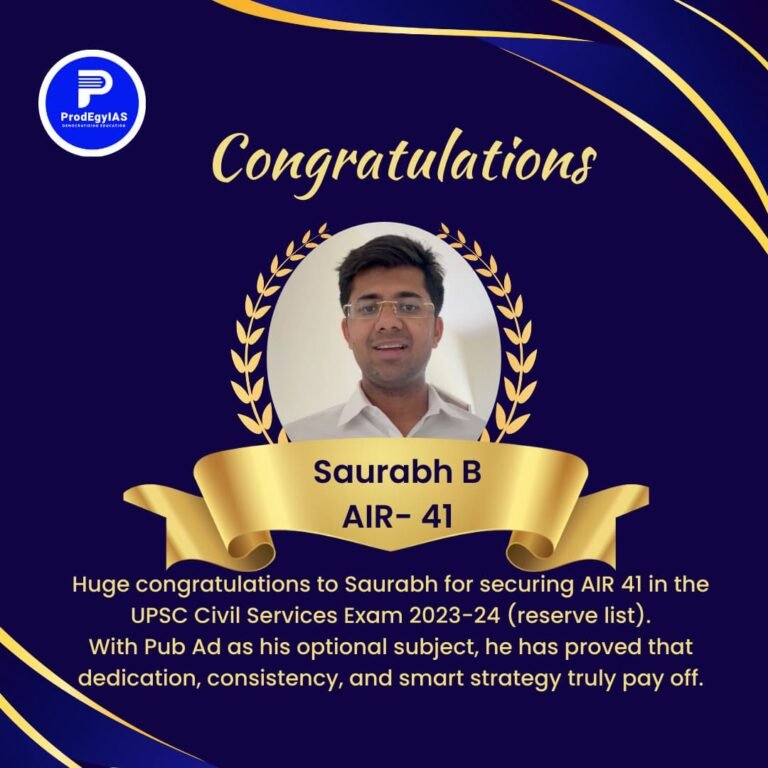
AIR 41
265 in Pub Ad
Saurabh B

AIR 42
302 in Pub Ad
Deepankar Chowdhary
AIR 48
309 in Pub Ad
Rizwan Basha Shaik

Rank 61
274 in Pub Ad
Khushali Solanki

Rank 122
290 in Pub Ad
Deepesh Gaur

AIR 180
286 in Pub Ad
Achyuth Ashok
1,500+
UPSC selections
Including IAS, IPS and IFS
What these results represent. These are ProdEgyIAS institutional Public Administration results achieved by students across the institute’s programmes — they are not results generated exclusively by this mentorship programme. No rank or mark is guaranteed.
You have already studied Public Administration. Now the question is what happens when you sit down to write. If you recognise some of these problems in your Paper I or Paper II answer writing, this programme is designed around exactly that stage of preparation.
Start with the Public Administration Foundation Course. This answer writing and mentorship programme works better once you have covered the syllabus and are ready to practise, get evaluated and improve your Mains answers.
A good answer is not built by adding more content everywhere. In this mentorship, you work on the decisions that matter while writing — understanding what UPSC is asking, deciding what belongs in the answer, structuring it within the word limit and using feedback to make the next attempt better.
01 — Question Demand
Before you start writing, learn to read the question closely and decide what kind of response it actually demands.
02 — Answer Structure
Once the demand is clear, build the answer before filling it with content. The focus is on giving every part a purpose.
03 — Value Addition
Not every answer needs every thinker, report or diagram. You learn to choose references that actually strengthen the argument.
04 — PYQ-Based Learning
This is not answer writing around random practice questions. Each weekend begins with PYQs so you can see how familiar syllabus areas are actually turned into Mains questions.
05 — Answer Evaluation
During the week, you attempt the assigned questions and submit them for written answer evaluation. The point is not simply to collect remarks, but to understand what should change in the next answer.
06 — Paper I ↔ Paper II
Public Administration becomes stronger when theory does not remain confined to Paper I. You learn where administrative concepts and thinkers can sharpen Paper II answers without forcing them in.
Saturday and Sunday do different jobs, but they are part of the same answer-writing process. Saturday helps you understand how a UPSC question should be read and framed. Sunday shows you how that framework works in a complete answer and prepares you for the practice questions you will write during the week.
The cycle then continues outside the live sessions. You attempt 2–3 PYQ-based questions, submit your answers and receive written feedback before the next Saturday. Every week moves through question analysis, answer framework, application, writing and evaluation rather than treating mentorship as a separate discussion after the course.
Framework on Saturday. Application on Sunday. Writing and feedback through the week. Then repeat.
The programme moves through the syllabus in a planned 16-week sequence. Paper I comes first, followed by Paper II, but every week stays centred on the same purpose: work with PYQs, understand the question demand, build the answer and practise writing it.
Paper I builds the conceptual base of Public Administration Optional answer writing. Across eight weeks, you revisit major thinkers, administrative theories, organisations, accountability, Comparative Public Administration, Public Policy, personnel and financial administration — but now through PYQs and Mains answer application.
Wilson · New Public Administration · New Public Management · Good Governance
Begin with the foundations of the discipline and work on how broad conceptual themes are converted into focused UPSC Mains answers.
Taylor · Fayol · Weber · Bureaucracy
Work with classical administrative thinkers and learn how their ideas can be used analytically rather than reproduced as theory notes.
Mayo · Follett · Barnard · Simon
Move into behavioural and decision-making perspectives, with emphasis on thinker-based PYQs, comparison and relevant application.
Decision-Making · Leadership · Motivation · Communication
Practise questions where concepts need explanation, comparison and administrative application rather than simple definitions.
Organisational Structures · PPP · Regulatory Authorities
Work on organisation-related questions and learn how institutional concepts can be structured with contemporary administrative relevance.
Legislative Control · Judicial Control · RTI · Citizen’s Charter · Social Audit · Governance
Use accountability mechanisms and governance concepts to build answers with institutional examples and relevant administrative value addition.
Riggs · Comparative Public Administration · Development Administration
Work through conceptual and thinker-led PYQs, including where comparative frameworks can strengthen analytical Public Administration answers.
Personnel Administration · Public Policy · Financial Administration · E-Governance · Budgeting
Bring major Paper I areas together through PYQs, answer frameworks and application before moving into Indian Administration.
Paper II shifts the answer-writing practice into Indian Administration. Here the emphasis is not only on knowing institutions and reforms, but on using Paper I concepts, constitutional context, committees, reports and contemporary governance developments where they genuinely strengthen the answer.
Evolution of Indian Administration · Bureaucracy & Democracy · Constitutionalism
Examine the administrative foundations of the Indian system and practise connecting institutional development with constitutional and administrative perspectives.
Cabinet Secretariat · PMO · Central Secretariat · Legislature · Executive · Judiciary
Work on institutional questions with attention to roles, relationships, accountability and changing administrative realities.
NITI Aayog · Centre–State Relations · Finance Commission
Practise questions involving federal administration, institutional coordination and changing Centre–State dynamics.
Collector’s Role · Civil-Service Reforms · Neutrality vs Activism · Governance
Connect administrative theory with the changing role of civil services, field administration and contemporary governance expectations.
CAG · First ARC · Second ARC · Implementation Gaps
Learn to use commissions and reform recommendations as analytical support rather than simply listing them in an answer.
Rural Governance · Panchayati Raj · 73rd Constitutional Amendment
Work on decentralisation, local administration and rural governance through constitutional, institutional and administrative perspectives.
Urban Local Government · 74th Constitutional Amendment · Police Reforms
Practise questions around urban administration, local governance and law-and-order institutions with contemporary administrative context.
Corruption · RTI · NHRC · Disaster Management · Governance · Full Revision
Bring Paper II themes together while revisiting their links with Paper I concepts and preparing for integrated Public Administration Mains answers.
Across Paper I and Paper II, PYQs are used to understand question demand, build the answer framework and decide where thinkers, committees, reports, Articles or examples genuinely add value. Students then apply the same approach in weekly writing and use written feedback to improve the next answer.
Before you enrol, check the current fee, batch schedule and joining details with the ProdEgyIAS admission team. You can also discuss where you currently stand with Public Administration answer writing and whether this 4-month programme fits your stage of Mains preparation.
Fee on requestcurrent fee to be confirmed
Confirm the current fee, batch schedule and joining details with the admission team before enrolling.
 Mrs. Reena Pandey
Co-Founder · Admission Counsellor, ProdEgyIAS
Mrs. Reena Pandey
Co-Founder · Admission Counsellor, ProdEgyIAS
Have questions about the programme, current fee or schedule? Speak with the admission team before enrolling to understand the details and whether the programme fits your present answer-writing stage. Call or WhatsApp +91-9990757586.
Support continues after you join the programme. For session information, weekly practice, answer submissions, programme material or other course-related help, you can contact the ProdEgyIAS team through the available student-support channels, or email info@prodegyias.com.
Tell us where you are with Public Administration answer writing, and speak with the team to see how the mentorship programme fits your current preparation stage.
Your details are used only for course counselling and admission assistance.
Watch selected class discussions and answer-writing sessions to see how Ashutosh Sir reads a UPSC Mains question, identifies its actual demand and builds the answer with the right structure, administrative concepts and relevant value addition.
Students searching for the best teacher for Public Administration Optional often compare teaching experience, subject understanding and answer-writing guidance. For a mentorship programme, one more thing matters: whether the faculty can work with your PYQs, answer frameworks and written responses closely enough to show you what needs to improve.

Founder & Lead Faculty · 14+ Years of UPSC Mentoring Experience
Ashutosh Pandey Sir is the lead Public Administration faculty at ProdEgyIAS, guiding students across Paper I, Paper II and Mains answer writing. His mentorship connects PYQ interpretation with answer structure, administrative thinkers, Paper I–Paper II interlinking and written feedback, so the guidance stays connected to the answers students are actually preparing.
Hear from students about their experience with Public Administration faculty guidance, answer writing and mentorship at ProdEgyIAS — from understanding difficult topics and working with PYQs to improving answer structure and getting guidance during their UPSC preparation.
Suman Saurav MohantyAIR 9 · Public Administration 299What I valued most was Ashutosh Sir’s way of making me think about Public Administration rather than simply memorise material. His discussions on concepts, PYQs and answer structure gave me much more clarity. Even outside regular teaching, I could approach him whenever I needed direction in my preparation.
Karishma NairAIR 14 · Public Administration 265Ashutosh Sir was always more than just a faculty member for me. There were stages in my preparation when I needed clarity not only about the subject, but also about how to manage the pressure and stay focused. His practical guidance during those phases helped me approach preparation with a calmer mind.
Rishita GuptaAIR 18 · Public Administration 312Scoring 312 in Public Administration was very special for me. What I remember most from my preparation is the depth with which Ashutosh Sir discussed the subject. He constantly pushed me to connect concepts, understand the demand of questions and think about how an argument would actually work in an answer.
Ashwini PandeyAIR 34 · Public Administration 309Answer writing was one area where I needed much more clarity. The discussions with Ashutosh Sir helped me understand that knowing a topic and writing a good UPSC answer are two different things. His emphasis on question demand, structure, interlinking and relevant content gradually changed the way I approached Public Administration answers.
Mrunalee JoshiAIR 36 · Public Administration 265One thing I really appreciated about Ashutosh Sir was that I could speak to him when I felt stuck in my preparation. He would listen to the actual problem before suggesting what to do next. That personal accessibility mattered a lot, especially during phases when preparation started feeling overwhelming.
Saurabh BAIR 41 · Public Administration 265Ashutosh Sir helped me look at Public Administration as a connected subject rather than a collection of separate topics. His way of linking theory, Indian Administration, PYQs and current issues made revision more meaningful. It also helped me understand how the same concept could be applied differently depending on the question.
Deepankar ChowdharyAIR 42 · Public Administration 302For me, one of the most useful parts of the preparation was discussing answers after understanding what the question actually demanded. Ashutosh Sir would focus on approach, structure and application rather than just adding more content. That helped me become much more conscious about what I was putting into an answer and why.
Rizwan Basha ShaikAIR 48 · Public Administration 309What stood out for me was the seriousness with which Ashutosh Sir taught Public Administration. Thinkers, administrative concepts and answer structure were not treated as isolated areas. The discussions helped me connect them while writing. Whenever I needed clarity about preparation or revision, I also had the opportunity to reach out and discuss it.
The programme uses Public Administration study material, recommended books and PYQ-based practice resources to support Paper I, Paper II and weekly answer writing. The focus is on material you can actually use while building frameworks, revising topics and improving Mains answers.
Use these resources while preparing frameworks and deciding what content can strengthen a Public Administration Optional answer.
The programme also gives you question-based material so that preparation stays connected with actual UPSC answer-writing practice.
Where required, the programme also prescribes Mohit Bhattacharya, Prasad & Prasad, Fadia & Fadia, Nicholas Henry, Second ARC Reports and Laxmikanth for relevant Public Administration and Paper II reference work.
Talk to the ProdEgyIAS team about the Public Administration Answer Writing & Mentorship Programme, upcoming schedule and how the weekly writing-and-feedback cycle works.
Contact Mrs. Reena Pandey: +91-9990757586 | info@prodegyias.com | www.prodegyias.com
Already know the syllabus but still figuring out how to practise PYQs, improve your answers or choose the right Public Administration mentorship programme? These are some of the questions worth asking before you join.
Start writing before you feel completely “ready”. Pick PYQs from topics you have already covered and check whether you can identify the demand, organise the argument and bring relevant thinkers or administrative examples into the answer. This programme builds that practice into a weekly Public Administration answer-writing cycle instead of keeping writing for the end.
Ask yourself a simple question: is my problem still understanding the syllabus, or using what I already know in an answer? If Paper I and Paper II still need first-time teaching, continue with foundation preparation. If you know the subject but struggle with PYQs, structure, relevance, value addition or consistency, mentorship becomes more useful.
It runs for four months across 16 weekends. Saturday focuses on decoding 3–4 PYQs and building answer frameworks; Sunday moves into application, model-answer discussion, doubts and mentorship. You then write 2–3 assigned answers during the week and receive written feedback before the next cycle begins.
Answer writing cannot guarantee a particular score, but it works on areas that directly affect how your knowledge appears on the paper: understanding the question, staying relevant, structuring the argument, selecting useful content and writing within limits. Knowing Weber or Riggs is one thing; deciding where and why to use them is another.
Usually, adding more material is not the first solution. Look at whether you have actually answered the directive, developed an argument and used subject-specific material where it belongs. Thinkers, committees, ARC references, Articles, governance examples or diagrams should sharpen an answer — not sit inside it simply because you memorised them.
You write the assigned PYQ-based questions during the week and submit them for written feedback. Evaluation looks at what is happening inside the answer — question interpretation, structure, relevance, content gaps, application and value addition — so that you know what to change in the next answer, rather than receiving only a score or generic remark.
Don’t use PYQs only as a list of questions to finish. Ask why UPSC framed the question that way, what the directive changes and which part of the syllabus it is really testing. In the programme, PYQs are decoded live first; you then use that understanding while attempting fresh PYQ-based questions yourself.
There is no useful universal number if the answers are written without review. In this programme, the normal cycle gives you 2–3 PYQ-based questions each week, alongside live discussion of 3–4 PYQs. The idea is to write, understand the feedback and apply the correction — not simply accumulate a large answer count.
First recognise that the available space changes what you can reasonably do. A 10-marker of roughly 150 words needs tighter selection; a 20-marker of roughly 250 words gives more room for development. In both, question demand comes first. Introduction, argument, value addition and conclusion should serve that demand rather than follow a fixed template.
Don’t begin with “which thinker can I insert here?” Begin with the administrative issue. If Weber helps explain bureaucracy, Simon helps illuminate decision-making, or accountability theory adds depth to an Indian Administration question, use it. The programme deliberately works on Paper I–Paper II interlinking so theory becomes an analytical tool rather than a memorised quotation.
Yes. The Public Administration mentorship programme is online, so you can join the live weekend sessions from outside Delhi as well. The academic cycle remains connected throughout the week: attend the live discussions, work on the assigned answers and continue with submission, feedback and the next weekend’s session.
It can be particularly practical when you already know the syllabus and mainly need a regular writing-and-feedback system. You do not have to relocate simply for answer-writing practice. What matters is whether you can attend the live sessions consistently, complete the weekly answers and actually use the feedback in your next attempt.
The weekend format can make it easier to manage alongside work because the two live academic sessions are concentrated on Saturday and Sunday, while the 2–3 assigned answers are written during the week. Still, compare the current timings and weekly workload with your job before enrolling rather than assuming that “online” automatically means effortless or completely flexible.
The programme is led by Ashutosh Pandey Sir, Founder and Lead Faculty at ProdEgyIAS, with 14+ years of UPSC mentoring experience. His role here covers Public Administration PYQ discussions, answer frameworks, Paper I–Paper II application, doubts and mentorship — so the programme is not designed as a set of disconnected practice questions without faculty guidance.
Don’t decide from a “best Public Administration teacher” claim alone. See how the faculty reads an actual PYQ, explains why an answer works or fails, connects Paper I with Paper II and gives usable correction. For answer-writing mentorship, the important question is not only who teaches, but also how closely the teaching connects with what you write.
Compare the actual academic process behind the label. Does the programme make you write regularly? Who evaluates the answers? Are PYQs decoded or merely provided? Is feedback specific enough to act on? Are both Paper I and Paper II covered? A good Public Administration Optional mentorship should create a repeatable write–review–correct cycle, not just add more lectures.
Yes. The academic resources include Public Administration Paper I and II handouts, PA Handbook references, the Prospective Question Bank, Second ARC material and weekly PYQ/practice support. These resources are meant to support answer building and revision. Confirm with the admission team which current materials are supplied physically, digitally or used as recommended references.
Ask about the current batch schedule, online session timings, fee, weekly workload, answer-submission process and how feedback is returned. Also tell the team honestly how much of Paper I and Paper II you have covered. That conversation matters because this programme is meant for answer-writing improvement, not first-time teaching of the Public Administration syllabus.

Complete course details, batch schedule, study material list and fee structure — in one PDF.
If you are in Delhi and would prefer to discuss your Public Administration answer-writing and mentorship preparation in person, visit ProdEgyIAS in Karol Bagh. You can meet the admission team, understand the programme and clear your questions before enrolling.
Discuss your Public Administration answer-writing preparation and get the current programme, fee and admission details.
Get the current schedule, fee and admission details.
Your details are used only for course counselling and admission assistance.